
How to Search Spartanburg County Court Records
The official starting point is the South Carolina Judicial Branch Case Records Search. From there you reach the Spartanburg County Public Index, which holds Circuit Court and Family Court records and some Municipal Court cases. The search is free. There is no account to set up. Spartanburg County is Circuit Number 7 and County Number 42, so you select it from the county list.
Before you start, turn on cookies and JavaScript. The Judicial Branch says both are required, and some browsers need a pop-up exception to open case detail. Have a name or a case number ready. One privacy change matters: as of January 1, 2026, home address information no longer shows on the public index for new or existing cases.
The steps below work for most case types.
- Open the SC Judicial Branch Case Records Search and pick Spartanburg County.
- Accept the public index disclaimer in the county portal.
- Search by case number if you have it. If not, use a party or business name.
- Narrow the list by court type, case type, and filing date.
- Click the case number to open the docket, parties, charges, hearings, and judgments.
- Contact the Clerk of Court for a certified copy or for any record not posted online.
The Judicial Branch warns that recent filings may not appear right away. For anything official, ask the Clerk.
The state lists every county court office on its courthouse page for Spartanburg County. That page is a quick way to confirm a phone number or a judge before you call.
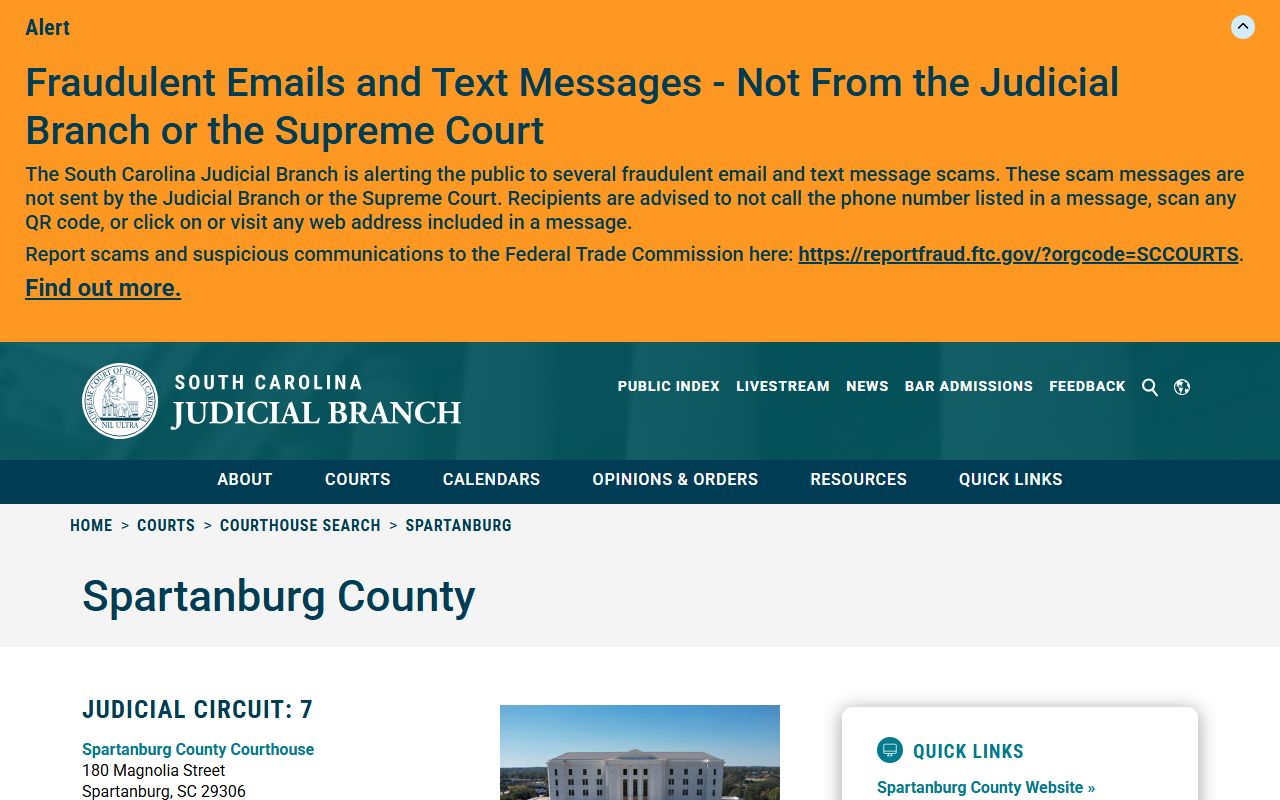
The county listing shows the circuit number, the courthouse address, the Clerk, the resident judges, and links to the trial courts. It is the cleanest official index of who does what in the Spartanburg County Court.
The Spartanburg County Judicial System
South Carolina runs one statewide, unified court system, but the work still splits across several venues. Circuit Court is the general trial court. It divides into Common Pleas for civil cases and General Sessions for crimes. Family Court takes domestic matters and juvenile cases. Probate Court is a separate county court for estates and marriage licenses. Below them sit the summary courts: Magistrate Court and Municipal Court handle traffic, small claims, and lower-level crimes.
Spartanburg County shares Circuit 7 with Cherokee County. Resident Circuit judges include J. Derham Cole Jr., R. K. Kelly, and Grace G. Knie. Family Court resident judges include Usha J. Bridges, Pete G. Diamaduros, Angela J. Moss, and M. T. Thigpen. Appeals from Circuit and Family Court move to the South Carolina Court of Appeals, with the Supreme Court of South Carolina at the top.
Case flow: Magistrate / Municipal Court › Circuit Court › Court of Appeals › Supreme Court of South Carolina
| Court | Jurisdiction | Case Types |
|---|---|---|
| Circuit Court | General trial court, Circuit 7 | Common Pleas civil suits; General Sessions felonies and serious misdemeanors |
| Family Court | Statewide trial court | Divorce, custody, child support, juvenile, abuse and neglect |
| Probate Court | County court | Wills, estates, marriage licenses, guardianships, commitments |
| Master-in-Equity | By reference | Foreclosures and equity matters |
| Magistrate Court | Summary court | Small claims, landlord-tenant, traffic, minor crimes, bond |
| Municipal Court | City summary court | City ordinance, traffic, lower-level crimes |
The full Circuit Court page breaks down Common Pleas and General Sessions, and the Master-in-Equity page covers foreclosure work.
Common Pleas, General Sessions, and Family Court
People often mix up the three main trial dockets. Common Pleas and General Sessions are both Circuit Court, but one is civil and one is criminal. Family Court is its own court. The table sorts out which is which and who keeps the file.
| Feature | Common Pleas | General Sessions | Family Court |
|---|---|---|---|
| Type of case | Civil suits, contracts, injury, foreclosure | Felonies and serious misdemeanors | Divorce, custody, juvenile |
| Who brings it | A private party | The Seventh Circuit Solicitor | A spouse, parent, or the State |
| Records keeper | Clerk of Court | Clerk of Court | Clerk of Court |
| Public online | Mostly yes | Mostly yes | Limited; many parts sealed |
For a deeper look at criminal cases, see Spartanburg County arrest records. For divorce filings, see marriage and divorce records.
Spartanburg County Courthouses
Almost every court function now lives in one place. The Spartanburg County Courthouse and Judicial Center at 180 Magnolia Street opened to the public in January 2024. It is a six-story, roughly 340,000-square-foot building with 17 courtrooms. Circuit, Family, Probate, Magistrate central operations, the Solicitor, the Public Defender, and court security all work from this address. Magistrate Court also runs three regional offices outside downtown.
Spartanburg County Judicial Center
180 Magnolia Street
Spartanburg, SC 29306
864-596-2591
Clerk of Court
180 Magnolia St, 2nd Floor, Suite 2100
Spartanburg, SC 29306
864-596-2591
Magistrate Court (Central)
180 Magnolia Street, 1st Floor, Suite 1119
Spartanburg, SC 29306
864-596-2564
The county built the courthouse with the 2017 penny sales tax, not a property-tax increase.
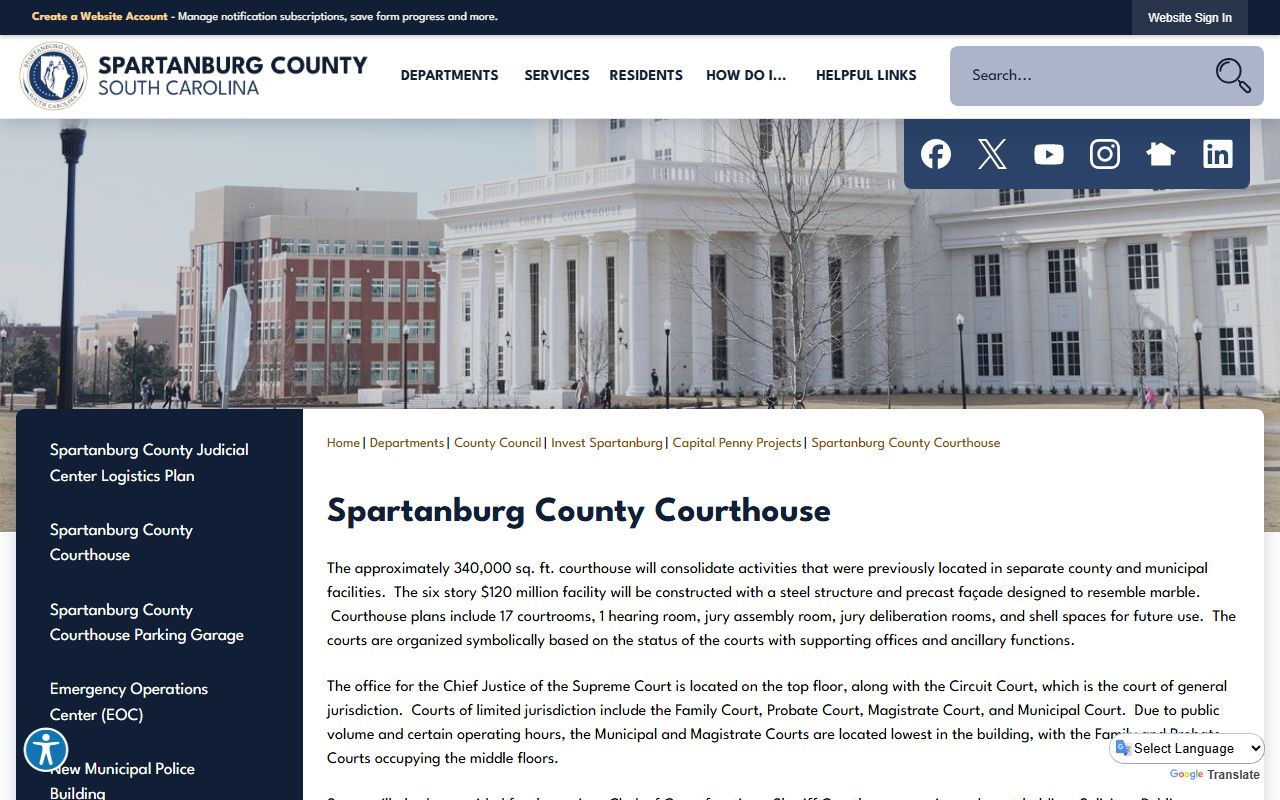
The county's courthouse project page lays out the building floor by floor, with high-volume summary courts on lower floors and Circuit Court space up top. That layout mirrors the state court hierarchy.
Clerk of Court Records and Copies
The Clerk of Court is the main records office for the Spartanburg County Court. Clerk Amy W. Cox serves both Circuit Court and Family Court. The office manages dockets, takes fees and fines, keeps the case files, and processes child-support payments in Family Court. Copies of General Sessions, Common Pleas, and Family Court records run through the Clerk's records contact. A separate office, the Register of Deeds, keeps recorded land documents.
Marriage license copies come from Probate Court, not the Clerk. Most court copy and search fees are not posted online, so call first. The fees below are the ones the county and state publish.
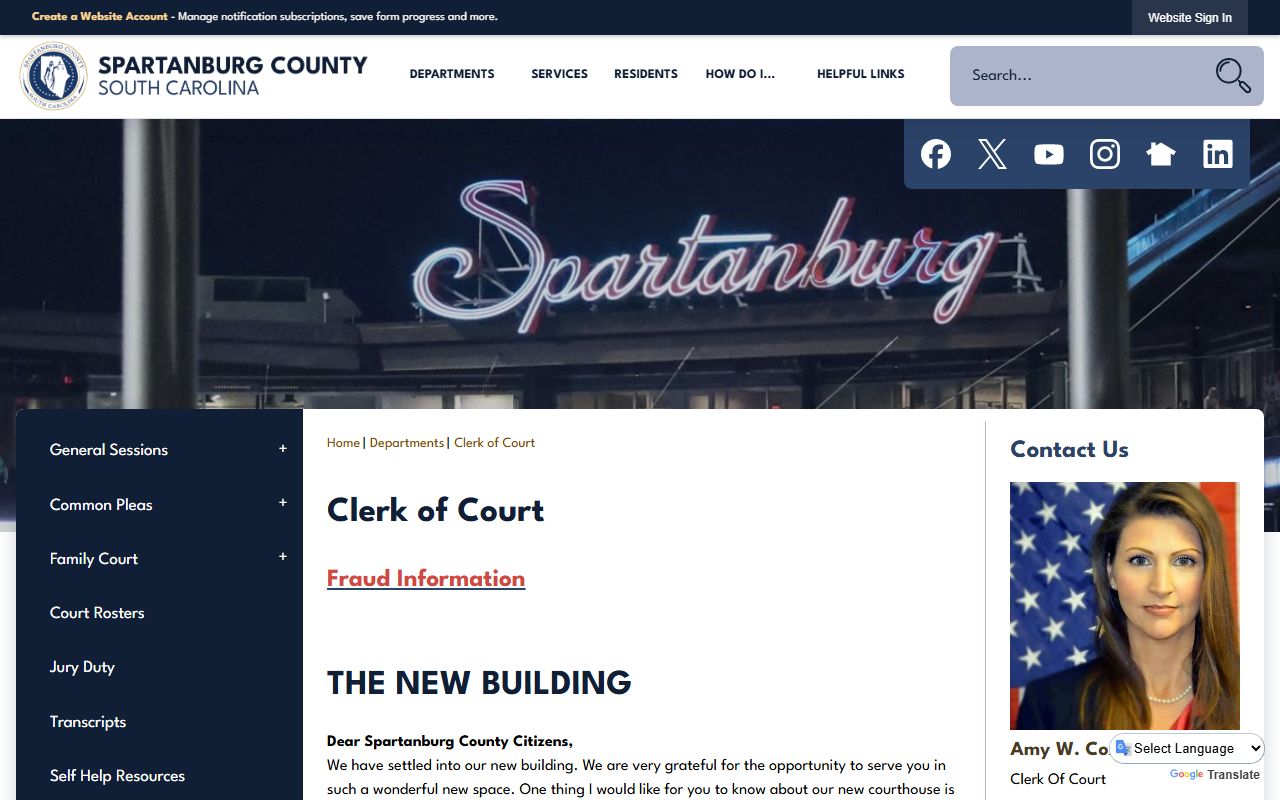
The Clerk of Court page lists each division contact, the parking note for the new courthouse, and the records email. Start there before a trip downtown. The full Clerk of Court page on this site covers forms and certified copies in more detail.
Spartanburg County Court Records Fees
Fees depend on the office and the record. A few are set by statute. The Probate Court charges a flat rate for a certified marriage copy. Expungement carries several separate fees unless an exception applies. Pretrial diversion programs charge their own fees.
| Item | Amount |
|---|---|
| Certified copy of marriage license | $5.00 per copy |
| Expungement solicitor administrative fee | $250 |
| SLED expungement verification | $25 |
| Clerk expungement filing fee | $35 |
| Pretrial intervention application | $100 |
| Pretrial intervention participation | $250 |
Dismissals, acquittals, and no-bill cases are often exempt from expungement fees. FOIA copy charges must stay reasonable and cannot top actual cost.
Types of Court Records Available in Spartanburg County
The Spartanburg County Court produces records across every division. Some are fully public. Others are sealed or limited by law. Which court made the record tells you where to look and how much you can see.
Here are the main categories.
- Civil / Common Pleas - lawsuits, contracts, injury, foreclosure, liens, and judgments.
- Criminal / General Sessions - felony and serious misdemeanor cases prosecuted by the Solicitor.
- Family Court - divorce, custody, child support, and juvenile matters, much of it restricted.
- Probate - wills, estates, guardianships, marriage licenses, and commitments.
- Traffic records - tickets and citations from Magistrate and Municipal Courts.
- Warrants and bonds - active, bench, Family Court, and General Sessions warrants.
What Spartanburg County Court Records Show
A case file holds a set of standard fields. The public index shows most of them once a case is filed. The search-field table lists the main ways to query the Spartanburg Public Index, and the data table shows what a result usually returns.
| Search Field | Type | Notes |
|---|---|---|
| Last / Business Name | Text | Use the first letters; punctuation may differ |
| Case Number | Text | Format like YYYY-XX-CC-NNNNN by case type |
| Court Agency | Dropdown | Common Pleas, General Sessions, Family, some Municipal |
| Filing Date From / To | Date | Narrows by date range |
| CDR Code | Text | Charge and disposition reference |
Once you open a case, the detail screen reads like the next table.
| Field | What It Shows |
|---|---|
| Case Number | The court's unique case ID, by year, type, and county code |
| Filing Date | When the case opened |
| Parties | Names and roles; home addresses removed as of 2026 |
| Charges / Cause | Charge description and CDR or statute code |
| Disposition | Case outcome, such as guilty, dismissed, or nolle prossed |
| Judgment | Final amount or sentence and any satisfaction status |
Public Access Laws for Spartanburg County Court Records
South Carolina starts from open access. The Freedom of Information Act gives the public the right to inspect and copy records held by public bodies, and county offices fall under it. Court files add their own rules through court orders, juvenile law, and privacy policy. When an office denies a FOIA request, the remedy is a Circuit Court action.
Key Statutes:
S.C. Code § 30-4-30 - gives the right to inspect and copy public records, with fees kept at or below actual cost.
S.C. Code § 30-4-40 - lists exemptions, including some law-enforcement investigation material and personal privacy.
S.C. Code § 17-22-910 - sets the criminal expungement process run through the Solicitor.
S.C. Code § 63-19-2010 - makes juvenile court and agency records confidential.
S.C. Code § 44-22-100 - keeps mental-health commitment records confidential.
The Spartanburg County public records page walks through filing a FOIA request and the fees involved.
Records That Are Restricted or Confidential
Not every court record is open. Juvenile records are confidential under state law and reach only a judge, the child's attorney, and a few authorized people. Mental-health commitment files held by Probate Court are closed. Adoption records are sealed. The public index hides sealed cases and any expunged charge. Personal identifiers like Social Security numbers and bank account numbers should never appear in a public filing.
To view a sealed record, a person usually needs a court order. Expungement questions go to the Seventh Circuit Solicitor, not the Clerk. The Clerk is required by statute to send those inquiries to the Solicitor's office, which administers eligibility, fees, SLED verification, and the order that clears the record across agencies.
Specialty Courts in Spartanburg County
South Carolina runs problem-solving courts that route eligible defendants away from standard prosecution. The Seventh Circuit Solicitor lists intervention programs, Drug Court, a Juvenile Arbitration Program, and a Worthless Check Program. Statewide, the Judicial Branch Treatment Court FAQ describes Adult Drug Court, Veterans Court, Mental Health Court, and several juvenile programs.
Pretrial Intervention is the most common diversion path. A person must apply within set deadlines, pay an application and participation fee, and finish the program. Success can mean a noncriminal disposition and destruction of the arrest record. The Alcohol Education Program and Traffic Education Program work the same way for qualifying charges, and inability to pay cannot bar a person from taking part.
Spartanburg County Sheriff and Jail
The Spartanburg County Sheriff's Office runs the Detention Center at 950 California Avenue and the booking portal the public uses to find inmates. Bill Rhyne is the current sheriff, sworn in after a 2025 special election. The Detention Services Division keeps the inmate population and the booked-and-released lists. The Sheriff's Office page warns that this booking data is for public awareness and is not a criminal-history report.
The Sheriff's Office home page links Bookings Search and the sex-offender registry. For the full roster details, see Spartanburg County inmate records, and for active warrants, see warrant records. Jail population numbers live on the inmate population page.
Marriage, Divorce, and Probate Records
Probate Court issues marriage licenses and certified marriage copies, and it handles wills, estates, guardianships, and commitments. Divorce is a Family Court matter, so the Clerk of Court keeps those files. For the steps to apply for a license or file a divorce, see marriage and divorce records. For estates and guardianships, see probate records.
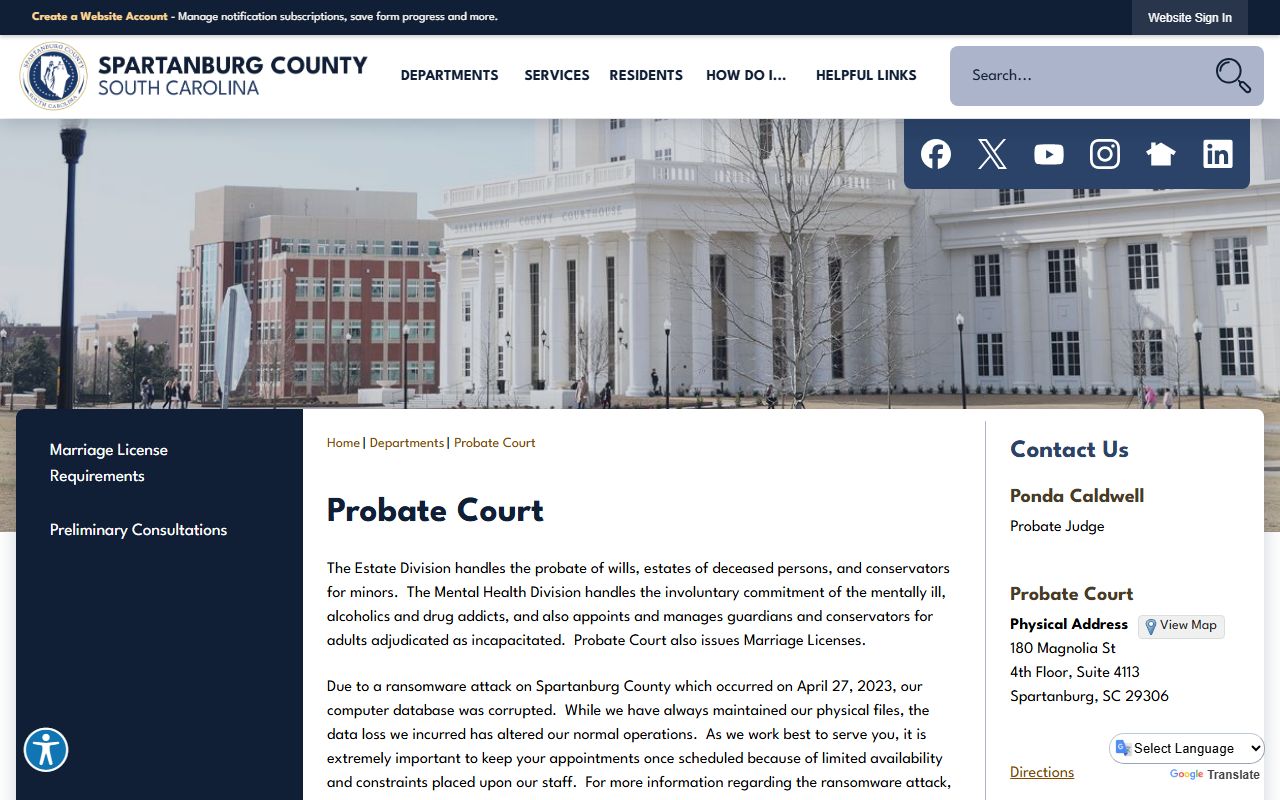
The county's Probate Court page covers marriage applications, the research room, and the appointment rule for reviewing physical files. A 2023 ransomware event makes those appointments more important than usual.
- Testator
- The person who made the will.
- Executor
- The person named to carry out the will.
- Conservator
- A person who manages money or property for someone who cannot.
How to Interpret Spartanburg County Court Records
Court files use shorthand. A case number opens with the year, then a code for the court and case type, then the county code, then a sequence number. CP marks Common Pleas, GS marks General Sessions, and DR marks domestic relations. A CDR code ties a charge to a disposition. "Nolle prossed" means the Solicitor dropped the charge. A disposition is the outcome, while a sentence or judgment is what the court ordered.
An arrest is not a conviction. A booking shows only that someone was charged and held. The case record, with its disposition, is what tells you how the matter ended.
Accuracy and Record Limitations
Online records lag behind real life. New filings may not post for days, and a jail roster can change by the hour. Sealed and expunged matters drop off the index entirely. If a record looks wrong, the office that made it is the one that can fix it. The Clerk handles court files. The Sheriff handles booking data.
Note: Confirm any case detail with the Clerk of Court or the originating office before you rely on it for a legal, job, or housing decision.
History of Spartanburg County Courts
Spartanburg began as a courthouse village, a spot picked to settle frontier disputes. That role came full circle in January 2024, when the new judicial center opened downtown. Voters approved the penny sales tax in 2017, groundbreaking followed in July 2021, and the old judicial center came down to make room for a public plaza.
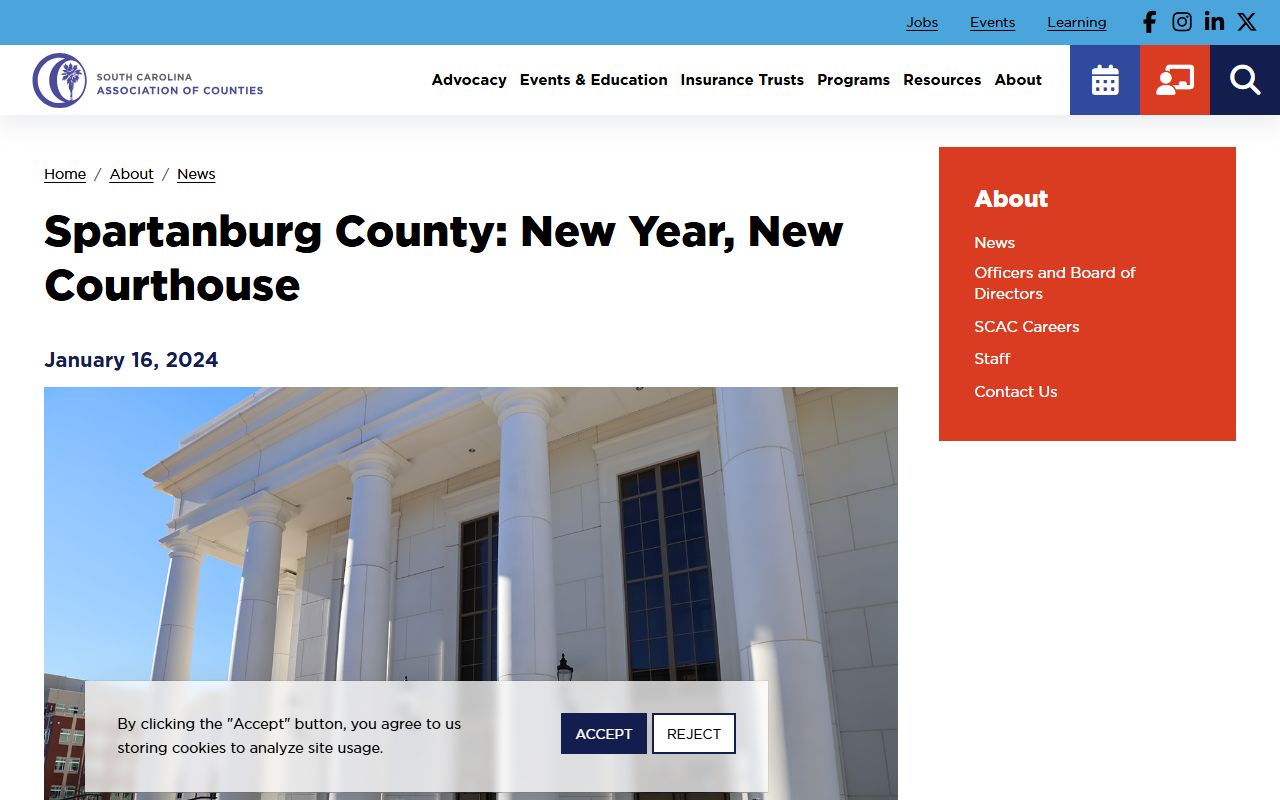
The South Carolina Association of Counties reported the funding timeline and the opening. The county notes that about 30% of the cost was paid by people outside the county through sales-tax spending, which is why there was no property-tax increase for the project.
Self-Help and Legal Aid in Spartanburg County
Court staff can explain how a case works and hand you forms, but they cannot give legal advice or predict an outcome. The Judicial Branch self-help page offers simple divorce, visitation, and order-of-protection packets. For income-based civil help, contact South Carolina Legal Services, which lists a Spartanburg office. The Spartanburg County Public Defender represents people who cannot afford a lawyer in criminal cases.
Frequently Asked Questions
Where do I search Spartanburg County court records?
Use the SC Judicial Branch Case Records Search and select Spartanburg County, Circuit 7 and County 42. The county Public Index is the main tool for Circuit and Family Court records. Some Municipal Court records appear too, but coverage varies. Probate and some Magistrate matters may need a direct call to the office.
Are home addresses shown in court searches?
No. The Judicial Branch removed home address display from the public index on January 1, 2026, for both new and existing cases. Other identifiers may also be redacted by rule, statute, or court order.
Who keeps certified court copies?
The Spartanburg County Clerk of Court handles copies for General Sessions, Common Pleas, and Family Court. Probate Court handles certified marriage copies and physical-file review for estates.
Where is the courthouse and where do I park?
The courthouse is at 180 Magnolia Street, Spartanburg, SC 29306. The Clerk points visitors to free parking at the Library Street Parking Garage and warns that mornings, lunch, and early afternoon are busiest. Build in time for the walk and security.
How do I find someone in jail?
Use the official Sheriff Bookings Search. The Detention Services page says its inmate population and booked-and-released lists are meant to identify current inmates and show bail and booking details. Call the Detention Center at 864-596-2607 to confirm.
How do I expunge a charge?
Contact the Seventh Circuit Solicitor. The Clerk must send expungement questions there. Article 9 of Title 17 sets the eligibility, forms, fees, SLED verification, and agency distribution.
More on the Spartanburg County Court Records FAQ page.